
In today’s evolving regulatory environment, private security companies are increasingly being asked to balance their responsibility to protect clients and property while navigating the complex landscape of immigration law and federal enforcement actions.
One question we frequently hear from residential property managers, corporate clients, and community stakeholders is: “What role should security officers play when Immigration and Customs Enforcement (ICE) arrives on private property?”
The answer lies in understanding the limits of authority, the scope of the law, and the rights of individuals on private premises.

Know the Legal Boundaries: What ICE Can (and Cannot) Do Without a Warrant
ICE agents have specific legal powers—but they must adhere to constitutional limitations. Security professionals should be aware of these distinctions:
- Administrative Warrants (Form I-200 or I-205) do not give ICE permission to enter private property without consent.
- Only judicial warrants, signed by a judge, grant ICE access to enter private spaces without permission.
- Security officers and building staff are not legally obligated to allow ICE onto private premises without a valid court-issued judicial warrant.
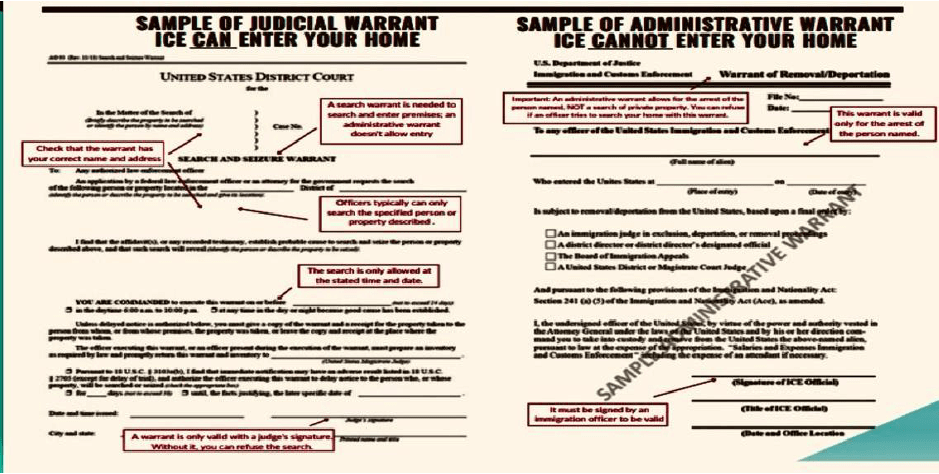
Understanding this distinction is vital. While officers should remain professional and respectful, they have a duty to protect access control, particularly on private property such as residential buildings, commercial facilities, or gated campuses.

Security’s Role in Protecting Client Rights
Security companies are not enforcement agencies. Their responsibility is to protect people and property within the limits of the law. This includes:
- Verifying warrants before granting access. Front-line staff should be trained to identify administrative vs. judicial warrants.
- Not voluntarily disclosing private resident or employee information without proper legal process.
- De-escalating interactions while contacting legal counsel or management.
- Documenting all encounters in incident reports for future reference.
Security companies must remind officers that it is not their job to interfere with ICE operations—but it is their duty to uphold the legal rights of those who live or work on the premises.
Training and Policy Development Are Critical
To ensure lawful and consistent responses, security companies should:
- Provide clear training on immigration-related enforcement protocols for all staff members.
- Have specific ICE response procedures in place orders to ensure there is a uniform response by security and management.
- Establish communication chains to notify property management or legal counsel in real-time.
- Emphasize non-discrimination policies, ensuring officers treat all individuals with dignity and respect, regardless of background.
Upholding Privacy, Law, and Professionalism

Private clients—especially those in residential and hospitality settings—rely on security companies not just for safety, but for professionalism and discretion. Officers should:
- Avoid questioning residents or employees about their immigration status.
- Never detain individuals unless there’s probable cause of a crime.
- Remain neutral and focused on property protection, not immigration enforcement.
Conclusion: Security and The Law
Immigration laws and policies in this country are in a state of flux. According to the non-partisan Government Accountability Office website www.gao.org, the current approved budget allocated a sum of $175 billion to anti-immigration efforts and approximately $30 billion will go directly to ICE. An additional $45 billion is earmarked for the construction of new immigration detention centers in this country.
However, The American Immigration Council www.americanimmigrationcouncil.org notes, there appears to be no oversight by either Congress or an independent monitor, to ensure that policies and procedures are being enforced correctly and judicially. Undoubtedly, this will lead to more chaos and confrontations on the streets of cities and communities. Private security professionals will need to become even more vigilant to how they respond on behalf of their clients during times of unrest. Private security’s responsibilities during protests, demonstrations and other civil disobedience will be discussed in future blogs.
The intersection of immigration enforcement and private security is not always clear nor simple to navigate. But with the right training, clear policies, and a strong leadership, understanding, the role security companies play can mitigate a disruption of services by lawfully protecting people and property while upholding the constitution and rights of all persons.
At Integrated Security Services, we are committed to educating our officers and clients about the legal framework surrounding these sensitive matters. Our officers are trained to deescalate by acting professionally, responsibly, and lawfully in every situation.
For more information or to schedule a policy consultation, contact us at
📞 1-888-808-9119 or 🌐 www.intesecurity.com
